
What it Means
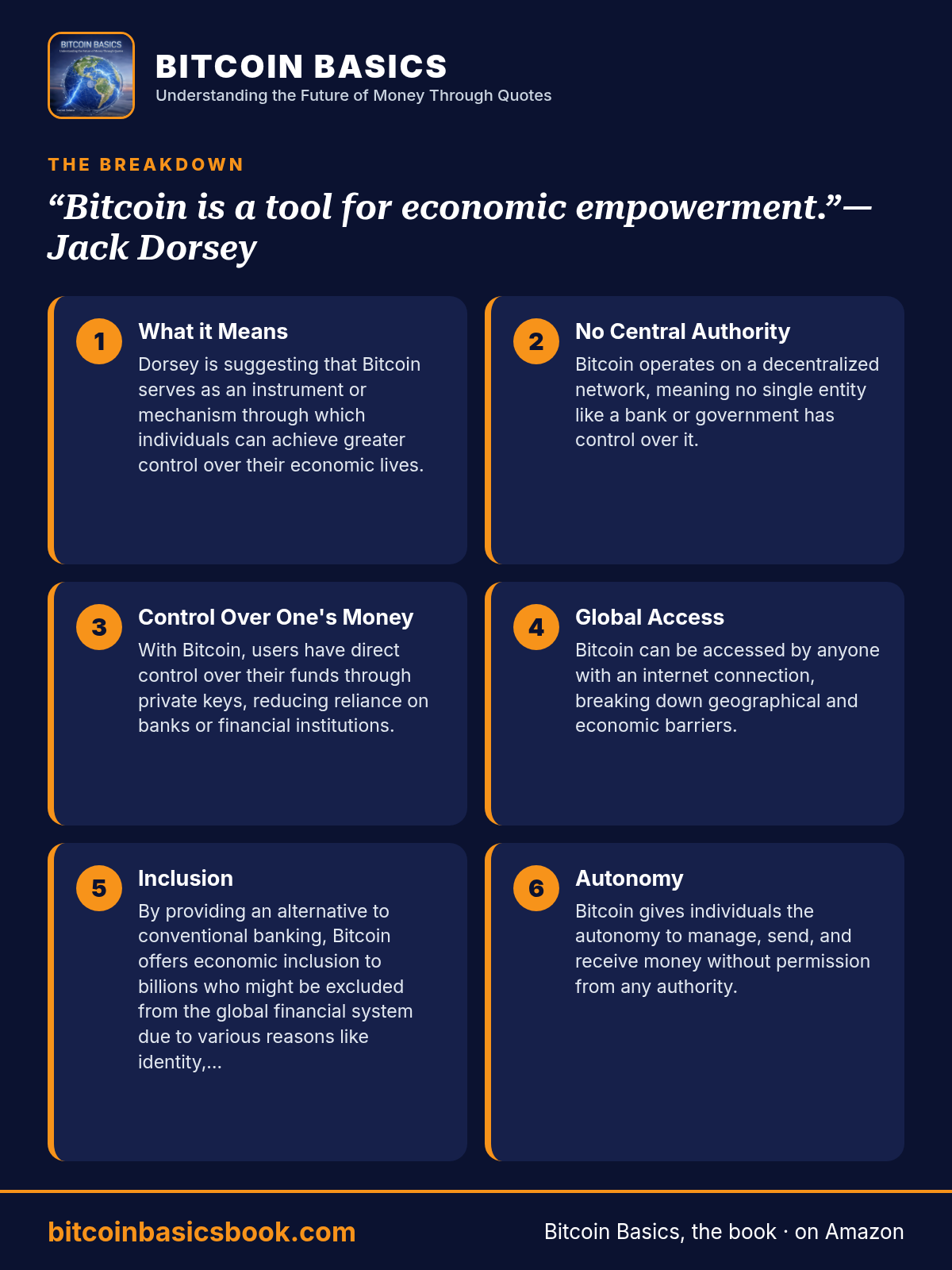
Dorsey is suggesting that Bitcoin serves as an instrument or mechanism through which individuals can achieve greater control over their economic lives. "Empowerment" here refers to giving people the power to influence their own financial destiny, beyond the constraints of traditional financial systems.
Decentralization:
No Central Authority
Bitcoin operates on a decentralized network, meaning no single entity like a bank or government has control over it. This decentralization is key to economic empowerment as it allows individuals to transact without needing intermediaries.
Control Over One's Money
With Bitcoin, users have direct control over their funds through private keys, reducing reliance on banks or financial institutions. This aspect empowers individuals by ensuring they are not subject to arbitrary account freezes, high fees, or exclusion from financial services.
Accessibility:
Global Access
Bitcoin can be accessed by anyone with an internet connection, breaking down geographical and economic barriers. This is particularly empowering for those in unbanked or underbanked regions where traditional banking is not accessible or is prohibitively expensive.
Inclusion
By providing an alternative to conventional banking, Bitcoin offers economic inclusion to billions who might be excluded from the global financial system due to various reasons like identity, location, or economic status.
Financial Sovereignty:
Autonomy
Bitcoin gives individuals the autonomy to manage, send, and receive money without permission from any authority. This independence from centralized control systems can be seen as a form of financial sovereignty, where one's economic actions are not dictated by external powers.
Resistance to Censorship
Transactions in Bitcoin are pseudonymous and, once confirmed on the blockchain, are difficult to reverse or censor, providing a level of privacy and freedom from financial surveillance.
Economic Opportunities:
Innovation in Finance
Bitcoin has spurred the creation of new financial technologies and services, like decentralized finance (DeFi), which can offer loans, savings, or investment opportunities without traditional financial gatekeepers.
Wealth Preservation
For some, Bitcoin acts as a hedge against inflation or currency devaluation, particularly in countries with unstable economies, thus preserving the purchasing power of their savings.
Empowering Individual Action:
Lower Transaction Costs
Bitcoin can reduce or eliminate the fees associated with international money transfers, making it cheaper for individuals to conduct business or support family abroad.
Micropayments
The technology also enables microtransactions, opening up new economic models for content creators, artists, or small-scale entrepreneurs who can now monetize in ways previously not feasible due to high transaction costs.
Philosophical Underpinning:
Freedom and Self-Reliance
Dorsey's statement aligns with a broader philosophical stance that sees Bitcoin as not just a financial tool but a means to promote freedom, self-reliance, and resistance to systemic financial oppression.
In essence, Jack Dorsey's quote underscores Bitcoin's potential to democratize finance, providing individuals with unprecedented control over their economic interactions, thereby fostering a more equitable, inclusive, and empowering global economic landscape.
Watch on YouTube
Hear more quotes like this one explained in our Quotes from the Book playlist, and subscribe to Bitcoin Basics on YouTube.
Curious about Bitcoin’s revolutionary potential? Grab your copy of Bitcoin Basics: Understanding the Future of Money Through Quotes to dive into wisdom from pioneers like this!
Get Your Copy Now: https://www.amazon.com/dp/B0DXCFY5QM
Stay ahead in the Bitcoin world!
Sign up for our exclusive newsletter for Bitcoin adoption insights, how-to guides, hilarious memes, the latest news, events, bitcoin apps, bitcoin websites, and more.


Leave a Reply