Not Like a Bank Account:
Bank Accounts
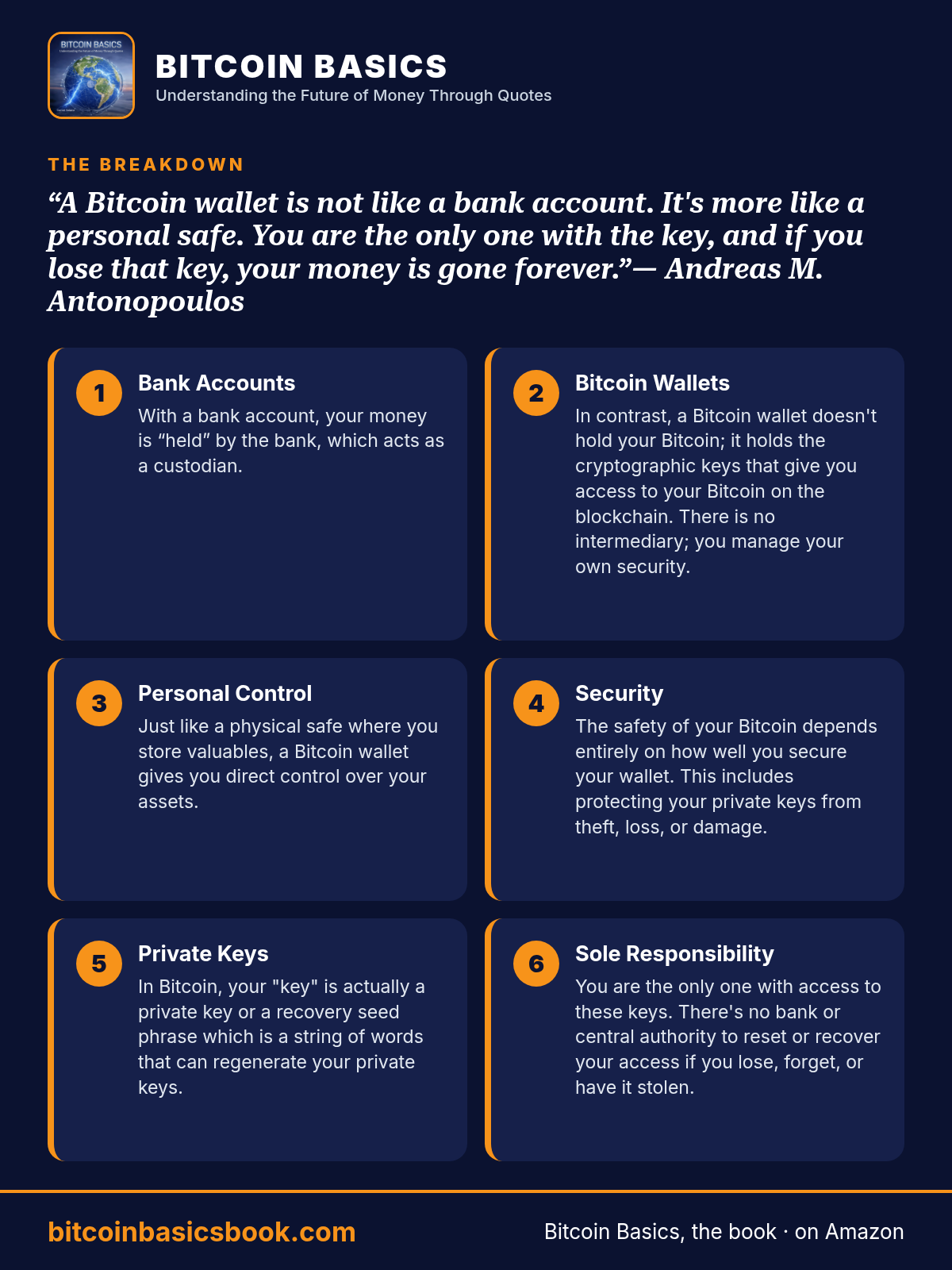
With a bank account, your money is “held” by the bank, which acts as a custodian. You have an account number, and the bank manages the security of your funds, offering services like overdraft protection, interest, and recovery options if you lose your card or forget your password.
Bitcoin Wallets
In contrast, a Bitcoin wallet doesn't hold your Bitcoin; it holds the cryptographic keys that give you access to your Bitcoin on the blockchain. There is no intermediary; you manage your own security. This means there's no customer service to call if something goes wrong.
More Like a Personal Safe:
Personal Control
Just like a physical safe where you store valuables, a Bitcoin wallet gives you direct control over your assets. You are responsible for securing both the safe (the wallet software or hardware) and the key (the private key or seed phrase).
Security
The safety of your Bitcoin depends entirely on how well you secure your wallet. This includes protecting your private keys from theft, loss, or damage. Unlike a bank, there's no physical vault, just digital security measures.
The Key Concept:
Private Keys
In Bitcoin, your "key" is actually a private key or a recovery seed phrase which is a string of words that can regenerate your private keys. This key allows you to sign transactions, proving ownership of Bitcoin.
Sole Responsibility
You are the only one with access to these keys. There's no bank or central authority to reset or recover your access if you lose, forget, or have it stolen. This aspect of Bitcoin emphasizes self-sovereignty but also self-responsibility.
Consequences of Losing the Key:
Irreversible Loss
If you lose your private key or seed phrase, you lose access to your Bitcoin permanently. There's no password reset, no customer support to call. Once lost, those Bitcoins are effectively gone from your control, as anyone who finds or steals your key can spend your Bitcoin.
No Recourse
Unlike losing a bank card where you might have insurance or bank protocols to recover funds, Bitcoin operates on a "you are your bank" principle. This makes the security of your keys paramount.
Implications for Users:
Security Practices
Users must adopt stringent security practices, like using hardware wallets, encrypting backups of seed phrases, or employing multi-signature wallets for added security.
Education
Understanding this responsibility drives the need for education in Bitcoin security, backup strategies, and the importance of not sharing or exposing your private keys.
In summary, Antonopoulos's comparison underscores the autonomy Bitcoin offers but also warns of the significant responsibility it places on individuals to manage their own security. This paradigm shift from centralized to self-managed finance is at the core of Bitcoin's ethos but requires users to be vigilant and knowledgeable about securing their assets.
Watch on YouTube
Hear more quotes like this one explained in our Quotes from the Book playlist, and subscribe to Bitcoin Basics on YouTube.
Curious about Bitcoin’s revolutionary potential? Grab your copy of Bitcoin Basics: Understanding the Future of Money Through Quotes to dive into wisdom from pioneers like this!
Get Your Copy Now: https://www.amazon.com/dp/B0DXCFY5QM
Stay ahead in the Bitcoin world!
Sign up for our exclusive newsletter for Bitcoin adoption insights, how-to guides, hilarious memes, the latest news, events, bitcoin apps, bitcoin websites, and more.


Leave a Reply