
What it Means
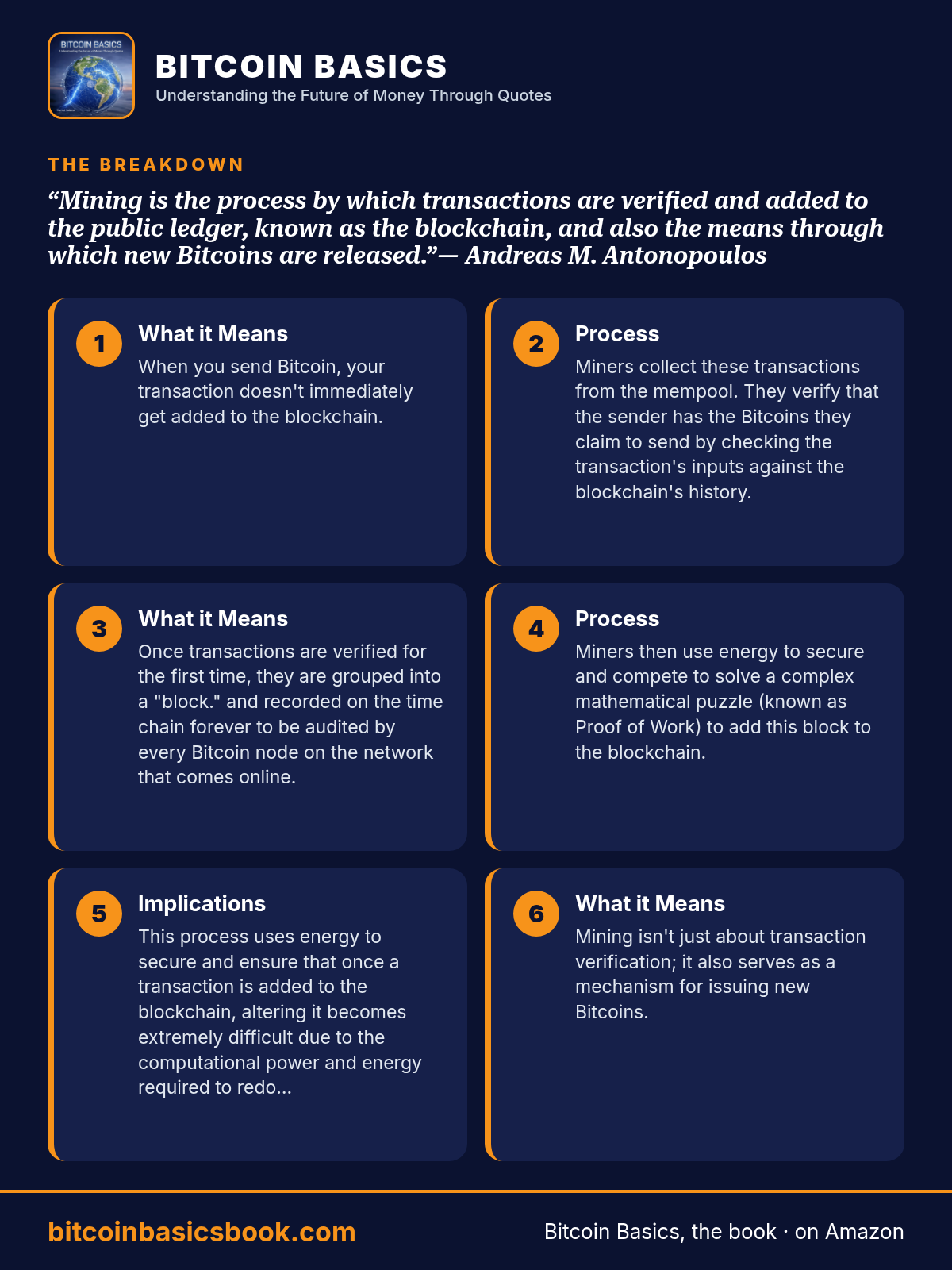
When you send Bitcoin, your transaction doesn't immediately get added to the blockchain. Instead, it enters a pool of unconfirmed transactions known as the "mempool." You can visualize this mempool in real time through different websites such as http://mempool.space
Process
Miners collect these transactions from the mempool. They verify that the sender has the Bitcoins they claim to send by checking the transaction's inputs against the blockchain's history. This involves cryptographic checks to ensure the transaction is valid, not double-spending, and adheres to the rules set by the Bitcoin protocol.
Adding Transactions to the Blockchain:
What it Means
Once transactions are verified, they are grouped into a "block" and recorded on the time chain forever to be audited by every Bitcoin node on the network that comes online.
Process
Miners then use energy to secure and compete to solve a complex mathematical puzzle (known as Proof of Work) to add this block to the blockchain. The first miner to solve this puzzle gets to add the block and receive the block subsidy + transaction fees for that block, which is then broadcast to the entire network. Each block is cryptographically linked to the previous one, forming a chain of blocks, hence "blockchain."
Implications
This process uses energy to secure and ensure that once a transaction is added to the blockchain, altering it becomes extremely difficult due to the computational power and energy required to redo all subsequent blocks.
Release of New Bitcoins:
What it Means
Mining isn't just about transaction verification; it also serves as a mechanism for issuing new Bitcoins.
Process
The miner who successfully adds a block to the blockchain is rewarded with newly minted Bitcoins. This reward halves approximately every four years in an event known as the "halving." Initially, the reward was 50 BTC per block; it's now 3.125 BTC, and it will continue to decrease until all 21 million Bitcoins are in circulation which is approximately the year 2140.
Purpose
This reward incentivizes miners to secure the network, providing an economic incentive for both network security and the distribution of Bitcoins into circulation.
Economic and Security Implications:
Security
By requiring high energy computational work to add transactions, mining makes it economically unfeasible to tamper with the blockchain, as an attacker would need to control more than half of the network's mining power (51% attack) to alter the blockchain's history.
Decentralization
Mining is conducted by individuals, and groups worldwide, promoting a decentralized system where no single entity controls the creation of money or validation of transactions.
In summary, mining is a critical component of Bitcoin's operation, ensuring both the integrity of transactions and the controlled release of new Bitcoins. It combines economic incentives with computational security to maintain the decentralized and trustless nature of Bitcoin.
Watch on YouTube
Hear more quotes like this one explained in our Quotes from the Book playlist, and subscribe to Bitcoin Basics on YouTube.
Curious about Bitcoin’s revolutionary potential? Grab your copy of Bitcoin Basics: Understanding the Future of Money Through Quotes to dive into wisdom from pioneers like this!
Get Your Copy Now: https://www.amazon.com/dp/B0DXCFY5QM
Stay ahead in the Bitcoin world!
Sign up for our exclusive newsletter for Bitcoin adoption insights, how-to guides, hilarious memes, the latest news, events, bitcoin apps, bitcoin websites, and more.


Leave a Reply