
On April 21, 2026, a pivotal moment unfolded in a U.S. Senate hearing room. Adm. Samuel Paparo, the four-star commander of U.S. Indo-Pacific Command (INDOPACOM), testified before the Senate Armed Services Committee on the posture of American forces in the Asia-Pacific region. When questioned by Sen. Tommy Tuberville about Bitcoin’s role in great-power competition—particularly against China—Paparo delivered remarks that sent shockwaves through the Bitcoin community.
“Bitcoin is a reality,” Paparo stated. “It’s a peer-to-peer, zero-trust transfer of value. Anything that supports all instruments of national power for the United States of America is to the good.”
He went further, highlighting Bitcoin’s underlying technology: “Bitcoin shows incredible potential as a computer science tool that, through the proof-of-work protocols, actually imposes more costs than just the algorithmic securing of networks and our ability to operate… It’s a valuable computer science tool as power projection… It has really important computer science applications for cybersecurity.”
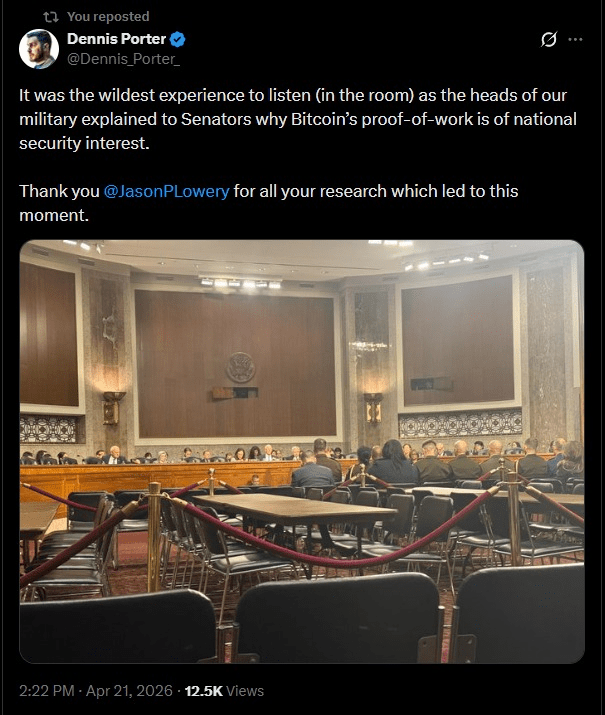
Moments later, Jason Lowery—a U.S. Space Force officer, MIT graduate, and author of the influential 2023 thesis Softwar—posted a single Latin phrase on X: “Alea iacta est.” (“The die is cast.”) This was Julius Caesar’s declaration upon crossing the Rubicon River in 49 BC, signaling an irreversible commitment to conflict and a point of no return.
Lowery’s post captured the gravity: Bitcoin may have just crossed its own strategic Rubicon in American national security thinking.
Understanding the Shift: From Digital Money to Strategic Technology
For over a decade, Bitcoin has primarily been discussed as money—a decentralized, scarce digital asset often compared to “digital gold.” Regulators, investors, and critics have focused on its price volatility, energy use, or potential as an inflation hedge.
Adm. Paparo’s testimony reframes the conversation. He didn’t dwell on Bitcoin as currency. Instead, he emphasized its proof-of-work (PoW) mechanism as a novel computer science innovation with direct implications for national power.
In simple terms, Bitcoin’s security doesn’t rely solely on complex algorithms or trusted intermediaries. It ties network security to real-world physical resources: electricity and specialized computing hardware. Miners compete to solve cryptographic puzzles, expending massive amounts of energy to add new blocks to the blockchain. This creates a thermodynamic cost—attacking or undermining the network isn’t just a matter of clever code; it requires burning enormous amounts of real energy.
Paparo noted that INDOPACOM is already researching Bitcoin’s fusion of cryptography, blockchain, and PoW, with potential applications in both defensive and offensive cybersecurity. The protocol doesn’t just secure transactions; it can “impose more costs” on adversaries operating in cyberspace.
This aligns closely with Jason Lowery’s Softwar thesis. In his 2023 MIT work, Lowery argues that Bitcoin should be understood not primarily as monetary technology, but as a new form of electro-cyber power projection. He calls this “softwar”—a non-kinetic way for nations to project physical power into the digital realm by making malicious actions prohibitively expensive in terms of energy and resources.
Lowery’s core insight: In cyberspace, where traditional physical deterrence (tanks, ships, missiles) is hard to apply, PoW turns the global electric grid into a kind of “macrochip” for enforcing rules and securing critical data at physical cost. Bitcoin’s network becomes a prototype for securing any valuable “bits of information”—financial, military commands, supply chain data—against state or non-state actors. http://dspace.mit.edu
Why This Matters: Geopolitics in the Indo-Pacific
The context of Paparo’s comments is critical. INDOPACOM oversees U.S. military operations across the world’s most contested region, including tensions with China over Taiwan, the South China Sea, and broader technological and economic rivalry.
Sen. Tuberville specifically asked whether Bitcoin leadership could give the U.S. an edge against China. China has historically cracked down on domestic crypto mining while reportedly exploring related technologies. Adversaries like Russia, Iran, and North Korea have used cryptocurrencies for sanctions evasion and funding operations.
Paparo’s endorsement suggests Bitcoin isn’t just surviving regulatory scrutiny—it could become an asymmetric advantage for the United States. By supporting “all instruments of national power” (diplomatic, informational, military, economic—the DIME framework), Bitcoin fits into a broader strategy of hybrid warfare and resilience.
This isn’t fringe speculation. It comes from a sitting combatant commander during defense authorization hearings for FY2027. Earlier developments, including U.S. discussions around a Strategic Bitcoin Reserve using seized assets, show institutional momentum building.
For the first time at this level, a senior military leader publicly treated Bitcoin’s PoW not as an environmental concern or speculative toy, but as a strategic computer science tool with real warfighting relevance.
Future Applications: Beyond Finance to National Security
If Paparo’s framing takes hold, what could “softwar” look like in practice? Here are grounded possibilities based on the testimony and Lowery’s thesis:
- Cyber Deterrence and Defense
PoW networks could make large-scale cyberattacks far more expensive by tying malicious actions to verifiable energy costs. A “Hash Force” or dedicated PoW-integrated command might emerge to protect critical infrastructure, military communications, or command-and-control systems in contested environments. - Energy as Strategic Power
Bitcoin mining’s flexible load could bolster grid resilience, especially with renewables or stranded energy sources. Abundant, cheap energy wouldn’t just power homes and industry—it could directly translate into greater national cyber resilience and power projection capability. - Secure Zero-Trust Operations
Peer-to-peer, zero-trust value and data transfer could support logistics, special operations funding, or allied coordination without vulnerable traditional banking rails—useful in gray-zone conflicts or sanctions-heavy scenarios. - Multi-Domain Integration
In a potential Taiwan contingency or broader Indo-Pacific crisis, influence over global hash rate or PoW standards could become as strategically relevant as control of sea lanes or satellite networks. PoW could secure tamper-evident logging for defense supply chains, reducing risks from counterfeits or sabotage. - Longer-Term Doctrinal Shifts
We may see increased DoD research funding, policy pilots, or even alliances built around energy-compute standards. Bitcoin could evolve into a foundational layer for securing the next-generation internet against disinformation, supply-chain attacks, or state-sponsored hacking.
Of course, challenges remain: energy consumption debates, regulatory hurdles, potential adversarial responses, and escalation risks if PoW networks become explicit targets. Implementation would require careful study, but the door is now open.
A Point of No Return?
Jason Lowery’s “Alea iacta est” was more than dramatic flair. It signaled that Bitcoin’s strategic recognition by senior U.S. military leadership may be irreversible. Once framed as a tool supporting American power projection, policy, research, investment, and doctrine tend to follow.
This doesn’t mean Bitcoin is suddenly a “military coin” or that every hodler is now a cyber warrior. But it does suggest we’re witnessing Bitcoin’s maturation—from a rebellious financial experiment to a foundational technology for 21st-century security, much like the internet or GPS before it.
For Bitcoin advocates, this is validation after years of skepticism. For policymakers and strategists, it’s a prompt to think seriously about proof-of-work’s unique properties in an era of hybrid threats and digital vulnerability.
The die is cast. The real question now is how the United States—and the world—will play the game.


Leave a Reply